
'For the first time in a hundred years, the army has been taken out of the political equation. And for the first time ever, there is only one man who calls the shots. Not even Mao had this kind of power.'

'The supreme art of war is to subdue the enemy without fighting.' Former RA&W official Jayadeva Ranade explains what China's military reforms mean for the world.

Xi has called on Chinese border troops to enhance their capabilities in border defence and control to forge a "great wall of steel" along the country's borders, it said.

'In the short term the relationship will get worse.'

Why can't the Indian government propose to the Chinese a corridor circumambulating the Holy Mountain where people from both sides could perform the yatra again? asks Claude Arpi.

The week-long 20th national congress of the Communist party of China began in Beijing on Sunday, October 16, 2022.
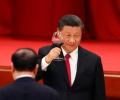
A high-profile conclave of the ruling Communist Party of China (CPC) has adopted a "landmark resolution" of the party's major achievements in the last 100 years besides paving the way for a record third term for President Xi Jinping next year.

China has been taking "incremental and tactical actions" to press its claims at the Line of Actual Control (LAC) with India and has unsuccessfully sought to prevent New Delhi from deepening its relationship with the US during and subsequent to the standoff, the Pentagon has said in a major report on China's military modernisation.

Addressing the centenary celebrations of the Communist Party of China at the historic Tiananmen Square, Xi in over an hour-long address also said that integrating Taiwan with the Chinese mainland is a historic mission of the ruling party.

Two elderly Chinese aerospace experts are hospitalised after a violent attack by a 'Princeling', states Jayadeva Ranade, the distinguished China expert and retired RA&W officer, highlighting the power the 'Princelings' ironically hold in the Communist People's Republic.

This is perhaps the most authoritative portrayal so far of Indian air power as a threat to China.
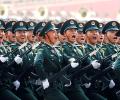
Currently, the reserve forces are under the dual leadership of military organs and local Communist Party committees and they would be brought under the control of the ruling party and the CMC from July 1, the state-run Xinhua news agency reported.
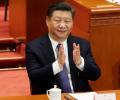
Xi has already been elected as general secretary of the ruling Communist Party of China at its once-in-five-year congress in October last year.

In democratic India, a citizen can be a patriot and at the same time be critical of the government, unlike China which promulgated a national security law in Hong Kong prescribing patriotism to contest elections, observes Rup Narayan Das.

'We must acknowledge China will use Pakistan against India.' 'We all need to know that these two countries are ready to destabilise India at all times.'

General Zhao Zongqi is well known in India for having commanded the Chinese troops during the Dokalam episode. Zhao knows every inch and corner of the Indian border, at least the Eastern and Central sectors, including the Naku La area which witnessed fist-fights between Indian and Chinese troops in April/May. Claude Arpi introduces us to the PLA generals masterminding the Chinese aggression in Ladakh.

A genuine attempt was made to reset relations in a positive way, signalling a stepping back from the brink of conflict, much to the relief of the world, observes Ambassador T P Sreenivasan.

What was the need for Xi Jinping, general secretary of the Chinese Communist Party, President of the People's Republic of China and Chairman, Central Military Commission, to don the new role of Commander in-Chief? Does this mean that the most powerful Chinese leader since Mao faces numerous threats from within the Communist Party?

'Even if there is no full-scale war, Galwan-like skirmishes cannot be ruled out.'
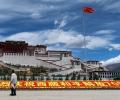
National security, consolidation of border defences and border security highlights China's Tibet policy, points out Jayadeva Ranade, the former senior RA&W officer and China expert.

'The intrusion in Chumar, during and beyond the Chinese president's visit, is unprecedented and has qualitatively changed the tone of the India-China relationship,' says Jayadeva Ranade, a member of the National Security Advisory Board.

'Tibetans will participate in future conflicts with India (in all probability, some were already present in Galwan).' 'As nobody in India would like to have a deadly fight with Tibetan soldiers and officers, the issue needs to be closely followed,' observes Claude Arpi.

'At the previous 18th party congress, Xi vowed to protect China's 'core' interests.' 'As a result, India faced a barrage of serious incidents on the borders with China -- at Depsang, Chumar, Pangong Tso and Doklam.' 'New Delhi will watch closely the political signals emanating from Beijing this week,' says China expert Srikanth Kondapalli.

'Everyone is unhappy with the lieutenant governor's administration, which is ignorant, high-handed, and inaccessible.'
A new book reproduces original Chinese maps that contradict Chinese propaganda. The book reveals Chinese intelligence admissions that Beijing never maintained any army base, customs office or other government function in the disputed area until 1983.

'Why did your generals try to grab a few square kilometres of Indian territory in Ladakh?' 'And what happened to the hard work that you and Prime Minister Modi put into the Wuhan and Mamallapuram meets?' Claude Arpi writes a letter to Xi Jinping, China's self-styled supreme leader, who turns 68 today, June 15.

By Thursday, 830 confirmed cases of pneumonia, caused by the novel coronavirus (2019-nCoV), had been reported in 29 provincial-level regions in the country.
'Our biggest advantage is that the troops are much better trained and motivated than the Chinese and can improvise and manage with a part of the resources.'
After the Ladakh fiasco where Xi Jinping did not expect the Indian Army to resist his land-grabbing tactics, he has to save face before his colleagues in the Communist party.' To bring the threat of a mega-dam to the northern Indian border is a clever move, observes Claude Arpi.

Important for India was Xi's meeting with representatives of PLA officers and soldiers stationed in Tibet. The video of the encounter was interesting to watch, especially the large number of lieutenant generals and major generals, observes Claude Arpi.

China is spending billions of dollars to improve infrastructure in Tibet and other parts of its border with India. Claude Arpi explains why New Delhi can't afford to ignore Beijing's plans.

We take a look at Time magazines top world leaders.
'As the first leaders of their respective countries born after Indian Independence and the Chinese Liberation, Modi and Xi would be expected to have the ability to overcome the traditional mindsets and the hierarchical nature of their official/bureaucratic establishments,' say Alka Acharya and Jabin T Jacob.

While acknowledging Shivaji's naval contributions, questions are being raised about the inadequate acknowledgement of Chola sea-power in southern Tamil Nadu, which dates back by a few centuries, explains N Sathiya Moorthy.

The India that needs strategic alliances, defence cooperation and engaging meaningfully with neighbouring countries is quietly moving ahead with confidence, says Tarun Vijay

No account of the 1962 war could be complete without Maxwell's authoritative analysis. Which is why we are reprinting this article which was run on Rediff.com in June 2001.
 © 2026 Rediff.com - Advertise with us - Disclaimer - Privacy Policy - Sitemap - Feedback - About us - Terms of use - Grievances